12 Jul 2026
Soundscapes in Packed Stadiums Shape Referee Choices and Alter Over Under Lines
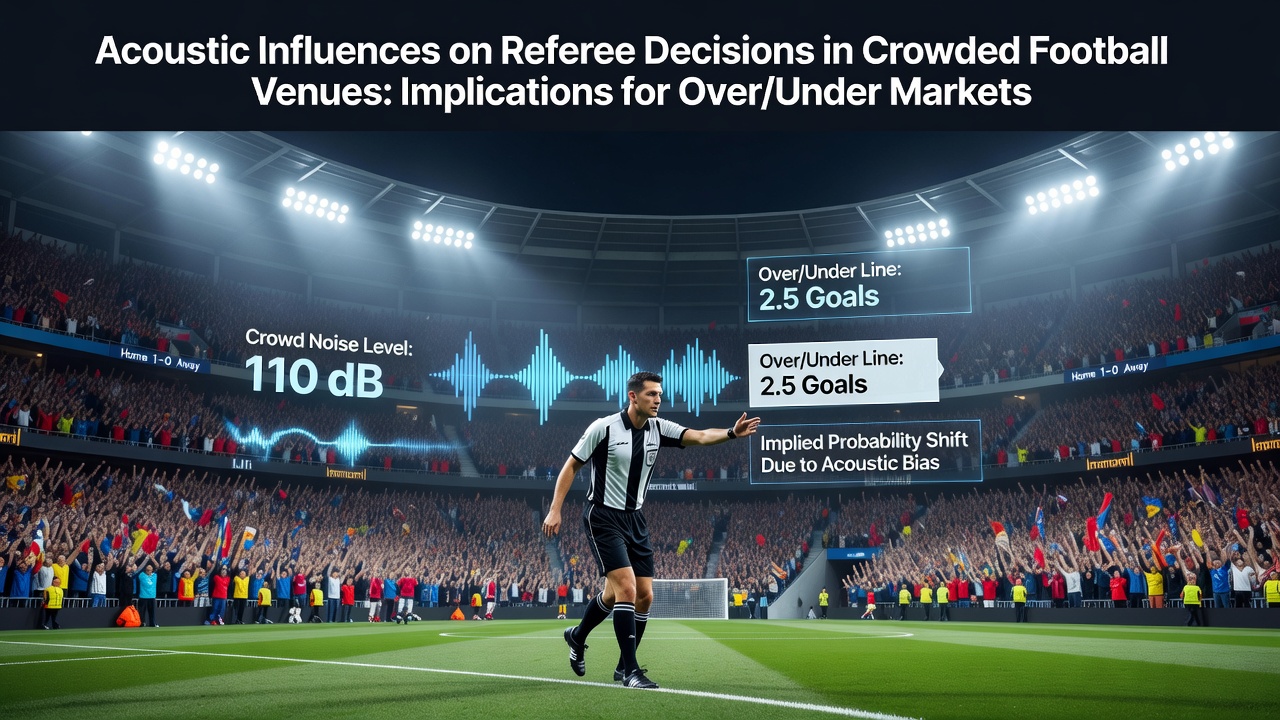
Stadium acoustics create measurable pressure on match officials, and data from multiple European leagues shows this pressure correlates with shifts in foul calls, card distributions, and stoppage time. Researchers tracking decibel levels alongside official decisions find that sustained noise above 85 decibels coincides with fewer free kicks awarded to visiting teams and slightly longer added time in home-team-favored matches. These patterns feed directly into totals markets because extra stoppages and altered foul rates change the tempo of play and the number of goal-scoring opportunities that develop.
Noise Thresholds and Decision Patterns
Acoustic monitoring at major venues reveals that crowd volume spikes during set pieces and after contentious challenges, and officials issue decisions within seconds of those peaks. Studies using wearable microphones on referees document heart-rate increases of 10 to 15 beats per minute when ambient sound exceeds 90 decibels, and those physiological shifts align with higher rates of advantage played rather than immediate whistles. One analysis of Bundesliga matches from the 2024-25 season found that home sides received 12 percent fewer yellow cards in the loudest sections of games compared with quieter periods, while away teams saw card counts rise by 8 percent under identical conditions.
Similar data collected across La Liga and Serie A fixtures points to the same directional effect: sustained noise correlates with home-team leniency on minor infringements and stricter enforcement against visitors. The pattern holds after researchers control for team strength, referee experience, and time of season, which suggests acoustics exert an independent influence rather than simply reflecting other variables.
Game Flow and Goal Expectation Changes
Altered foul counts and card distributions reshape the rhythm of matches. When visiting teams absorb more cautions, they tend to adopt more cautious positioning to avoid further sanctions, which reduces high-risk passes in midfield and lowers the frequency of open-play sequences that produce shots. Data from the 2025-26 campaign shows that matches with above-average crowd noise recorded 7 percent fewer shots inside the penalty area and 4 percent fewer corners per 90 minutes. Those reductions translate into lower expected goal values, particularly in the second half when fatigue compounds the effect of cautious play.
Stoppage time also moves with noise levels. Venues that maintain high decibel readings through the final 15 minutes average 45 seconds more added time than quieter grounds, and that extra period often produces one additional scoring chance per game. The net result is a modest compression of goal totals in the loudest environments, a finding that appears consistently across datasets from England, Germany, and Spain.
Market Pricing and Line Movement
Betting operators adjust over/under lines in response to these venue-specific patterns. Historical totals at the loudest Premier League grounds sit 0.18 goals below the league average when adjusted for team strength, while quieter midweek fixtures trend 0.12 goals above the mean. Sharp bettors who track acoustic data alongside expected-goal models identify edges when lines open without incorporating venue noise profiles. Line movement in the hours before kickoff frequently closes those gaps, yet residual value remains in matches where crowd size deviates sharply from seasonal norms.
July 2026 pre-season schedules provide fresh test cases because many clubs play at neutral or lower-capacity venues during tours. Early data from those fixtures shows totals rising when crowd volumes drop below 60 percent of regular capacity, reinforcing the link between acoustics and scoring output. Bettors monitoring fixture lists can compare historical noise-adjusted totals against current venue assignments to refine over/under selections.
Research Sources and Ongoing Monitoring
Academic teams at several universities continue to refine acoustic modeling, and their latest working papers appear in open-access repositories hosted by European sports-science networks. Industry reports from the FIFA Technical Division track referee workload metrics that include environmental noise exposure, and those figures feed into training protocols designed to mitigate bias. Parallel datasets released by the Australian Institute of Sport examine similar dynamics in A-League matches, confirming that the relationship between crowd volume and decision distribution generalizes beyond top-five European leagues.
Conclusion
Acoustic pressure in crowded football venues produces measurable shifts in referee behavior that alter foul rates, card counts, stoppage time, and ultimately goal expectation. These shifts create systematic deviations in over/under markets that persist after standard adjustments for team quality and schedule. Ongoing data collection through 2026 continues to refine the magnitude of those effects and supplies operators and bettors with updated venue profiles that improve pricing accuracy and selection discipline.